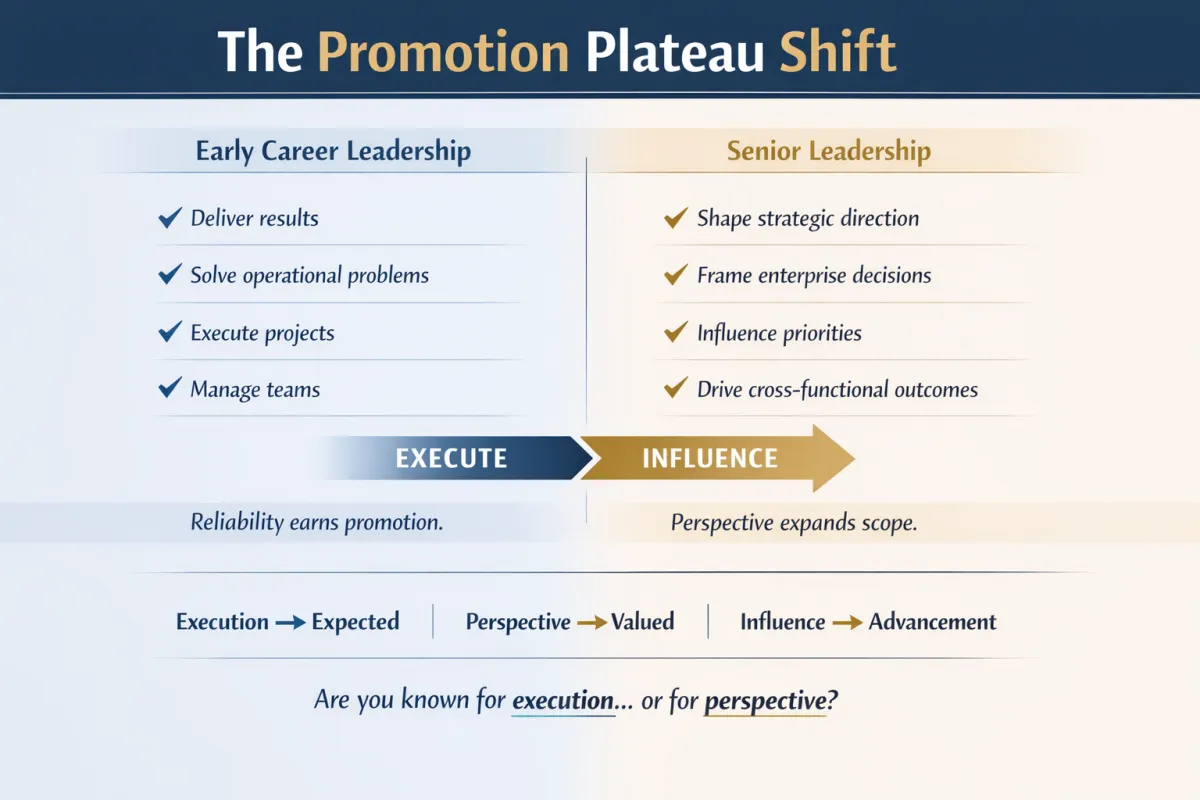
Why High Performers Plateau After Promotion
At the beginning of a career, the formula is simple.
Work harder.
Be better than the people around you.
Deliver results consistently.
That formula works for a long time.
It earns promotions.
It builds credibility.
It creates a reputation for reliability.
But then something surprising happens.
The very habits that made you successful suddenly stop producing the same upward momentum.
You’re still performing.
Still delivering.
Still solving problems.
Yet advancement slows… or stops.
This is the moment many high-performing leaders quietly hit a plateau.
And it’s not because they stopped performing.
It’s because performance stopped being the deciding factor.
The Shift Most Leaders Miss
Early leadership advancement rewards execution.
If you:
deliver results
manage complexity
solve operational problems
hit goals consistently
you move forward.
But once someone reaches Director or VP level, something changes.
Competence becomes assumed.
Everyone at the table can execute.
What separates the next level of leaders is something different:
Strategic positioning
Enterprise influence
Clarity of leverage
In other words:
Execution gets you promoted.
Positioning determines how far you go next.
The Plateau Pattern
Many high performers plateau after promotion because they keep operating with the same strategy that worked earlier.
They double down on being:
the problem solver
the reliable operator
the person who fixes everything
At first glance, this looks admirable.
But inside large organizations, it quietly creates a positioning problem.
When leaders become the go-to executor, they often become invisible strategically.
Their value becomes associated with:
fixing issues
managing complexity
delivering outcomes
instead of shaping direction.
And shaping direction is what senior leadership roles are built around.
Why This Happens to Smart Leaders
This pattern isn’t about capability.
It’s about incentives.
High performers were trained their entire careers to believe:
“If I perform well enough, recognition and advancement will follow.”
That belief is mostly true earlier in a career.
But senior leadership operates on a different dynamic.
At higher levels, organizations ask different questions:
Who shapes the strategic direction?
Who influences cross-functional decisions?
Who expands enterprise leverage?
Who is seen as operating at the level above their role?
Notice what’s missing from that list.
Pure execution.
The Real Transition After Promotion
The leaders who continue advancing after promotion make a shift that many others never consciously make.
They move from being responsible for outcomes to shaping the conditions that produce outcomes.
That includes:
influencing priorities across teams
clarifying strategic tradeoffs
defining direction instead of just delivering it
positioning themselves as enterprise thinkers
This is not about doing less work.
It’s about changing the type of value you create.
A Simple Diagnostic Question
If you want to know whether you are drifting toward a promotion plateau, ask yourself one question:
When leadership discussions happen, are you known for execution… or for perspective?
Execution earns respect.
Perspective earns influence.
And influence is what expands scope.
What Breaks the Plateau
Breaking a plateau rarely requires working harder.
It requires recalibrating how you are positioned inside the enterprise.
That usually means:
articulating your strategic leverage more clearly
expanding your influence across functions
shifting from operational problem-solving to strategic framing
making your thinking visible at the enterprise level
This is the transition many leaders are never explicitly taught.
Yet it’s the one that determines who keeps advancing.
Bottom Line
High performers plateau after promotion not because they stopped performing — but because performance stopped being the deciding factor.
At senior levels, advancement follows strategic influence, not operational excellence.
If you’re navigating that shift and want help thinking it through, you can schedule a conversation here:
Book a discovery call:
https://schedule.theunshakablemind.net/widget/bookings/coaching-discovery-call-with-kole


