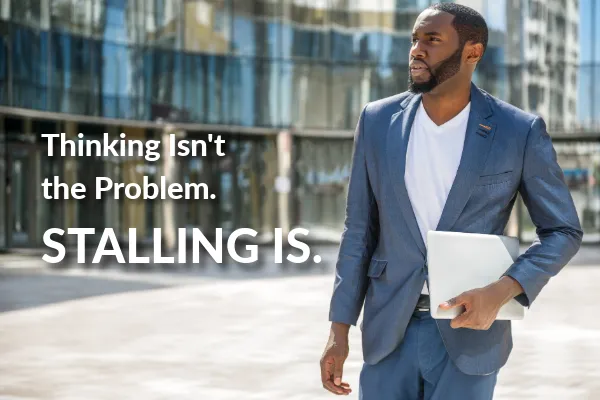
When Overthinking Is Actually Self-Protection
Most people think overthinking means something is wrong with them.
That they’re indecisive.
That they lack confidence.
That they just need to “trust themselves more.”
But that’s not what I see in my work.
Overthinking usually shows up in capable, responsible people — the ones who’ve learned that being careful keeps things from falling apart.
At some point in your life, thinking things through worked.
It helped you avoid mistakes.
It kept you safe.
It earned you trust.
The problem isn’t that your brain learned this strategy.
The problem is that it never got the memo that the situation changed.
Overthinking Isn’t the Enemy — It’s an Old Job Description
If you’ve ever wondered, “Why do I keep going in circles even when I know better?”
Here’s the answer most people miss:
Overthinking is often your nervous system saying,
“Last time we moved too fast, it cost us. Let’s slow this down.”
That’s not weakness.
That’s protection.
The issue is that protection can quietly turn into paralysis.
Instead of helping you decide, it keeps you rehearsing.
Instead of reducing risk, it delays movement.
Instead of creating safety, it creates exhaustion.
What Overthinking Actually Costs You
Overthinking doesn’t usually blow things up all at once.
It drains you slowly.
It shows up as:
• Re-opening decisions you already made
• Looking for the “right” answer when several would work
• Waiting to feel ready before taking the next step
• Second-guessing yourself after you’ve acted
And the real cost isn’t just time.
The deeper cost is self-trust erosion.
Each time you override your own judgment in favor of more thinking, your confidence takes a quiet hit. Not because you’re wrong — but because you’re teaching yourself that action requires permission from certainty.
And certainty never comes.
The Shift That Changes Everything
Here’s the reframe that matters:
Overthinking doesn’t need to be eliminated.
It needs to be retired from decisions it no longer qualifies for.
Some decisions genuinely need analysis.
Most do not.
The skill isn’t “stop thinking.”
The skill is learning to recognize when thinking has stopped being useful.
A simple test I use with clients:
“Is this thinking helping me choose — or helping me avoid choosing?”
If it’s the second one, you already have enough information.
A Grounded Way Forward
When you catch yourself looping, try this instead:
Name what you’re protecting yourself from.
Failure? Disappointment? Regret? Let it be explicit.
Decide what level of certainty is actually required.
Most decisions don’t need 100%. They need commitment.
Choose one small action that moves you out of analysis and into experience.
Momentum answers questions thinking never will.
You don’t build trust in yourself by waiting.
You build it by acting — and seeing that you can handle what follows.
This Is Where Coaching Often Comes In
Many of my clients don’t come to me because they lack insight.
They come because they’re tired of carrying decisions alone — and mistaking caution for wisdom.
Having a steady, external place to sort through decisions helps separate true discernment from old protection patterns that no longer fit.
Not to rush.
Not to push.
But to move honestly.
Bottom Line
Overthinking isn’t a flaw — it’s a strategy that’s overdue for an update.
If you’re ready to make decisions without needing perfect certainty,
you don’t need more information.
You need a steadier way to move forward.
👉 Book a Discovery Call with Kole
https://schedule.theunshakablemind.net/widget/bookings/discovery-call-with-kole


